A Train Station
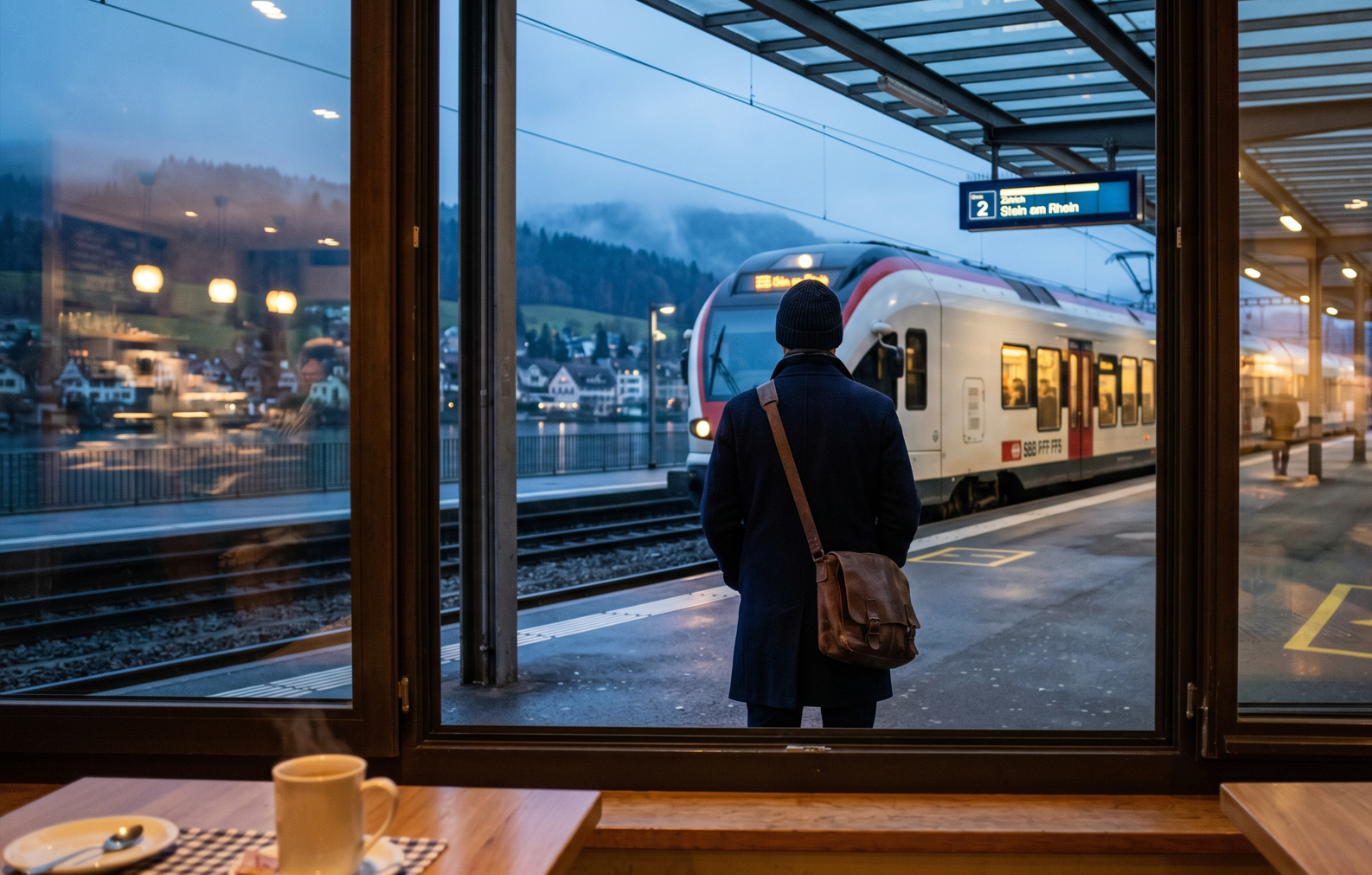
Swiss trains are never late. Not really. Not unless something has gone terribly wrong somewhere deep in the mountains. They pass through snow, tunnels carved into stone, violent rain, and impossible terrain, yet somehow they still arrive at the exact minute written on the board. Sometimes I used to think the steel understood time better than we ever could.
For nearly two years, I worked as a doctor not for humans, but for steel. I inspected tracks and signal systems, measured vibrations and alignment down to the millimeter, searching for problems no passenger would ever notice unless something failed. It was quiet work in theory, but never in reality.
My mornings began long before sunrise with bitter black coffee poured from a metal thermos and cigarettes smoked beside other engineers under a cold gray sky. There was always noise, the distant groan of locomotives, the metallic scream of wheels cutting through curves, radios crackling with updates from stations across the line. If you have never stood beside a Swiss locomotive tearing through a mountain pass, you cannot understand the sound of it. It is not just noise; it is something alive. The vibration climbs through the soles of your boots and settles somewhere deep in your chest.
We didn't speak much during those mornings, but none of us were lonely. Auditors, engineers, mechanics, signal workers, we were all tied together by the same obsession with keeping the system perfect. For two years, my world was measured in decibels, grease stains, and precision. And strangely, life felt simple there. Predictable. Safe.
Then the transfer came.
They pulled me away from the tracks and placed me behind a mahogany desk as a Planning Engineer. Now my mornings begin in Stein am Rhein ,a town so beautiful that it feels like someone painted it away from the crowd of Zürich with the Rhine flowing peacefully. But this peace and beauty is unbearably quiet for me, with only four people working alongside me, each in their own cabin. I rarely see them. To a man who spent years surrounded by the roar of iron and machinery, the silence felt unnatural. It follows me from my small apartment through empty streets, to my office, to an evening railway canteen where I usually wait for the train home.
I crossed the bridge over the Rhine while the cold air moved quietly through my coat sleeves. Below me, the water carried the pale blue color of the sky, disturbed only by slow passing boats. Stein am Rhein looked almost untouched at that hour. The medieval houses, painted in faded colors, stood silently beside narrow stone walkways dried by the sunlight.
There was a flower shop halfway to the station. Buckets of fresh flowers were always arranged outside the entrance, no matter the season. Tulips. White roses. Sunflowers during warmer months. Sometimes I slowed my pace there without understanding why. I often caught myself wondering who bought flowers on ordinary weekdays. Surely people did not wake up every morning thinking of someone else.
Most evenings, I missed the train.
Not accidentally. I simply stopped hurrying for it.
The station canteen sat near the far end of the platform where smoking was still permitted. I always chose the same corner table beside the window the one furthest from the noise of the passengers. By the time the next train arrived, two cigarettes were usually gone and the coffee had already turned cold.
The staff learned not to interrupt me much. A black coffee would appear beside my newspaper before I even asked for it. Most days I read the financial section without remembering a single thing I had read afterward. The faces printed there all looked the same to me serious men pretending numbers mattered more than life.
That evening, a soft voice interrupted my thoughts.
"Your hot chocolate."
I looked up, confused.
A young woman stood beside the table balancing a tray awkwardly in one hand. Dark hair tied behind her head. Blue eyes. Nervous enough to avoid holding eye contact for more than a second.
"That's not mine," I said.
She immediately checked the number hanging at the edge of the table and her expression tightened.
"I'm sorry. First day."
She disappeared before I could answer. A few minutes later she returned with the correct cup of coffee, setting it down carefully this time. Then she glanced at the newspaper in front of me and smiled lightly.
"That paper looks depressing."
I looked down at the front page. Nobody there was smiling.
"Well," I said quietly, "I suppose that's what normal people look like."
She laughed — not politely, but genuinely — and walked away toward another table.
For some reason, I kept staring at the newspaper long after she left. The faces on the front page looked exactly the same as before, but her comment had unsettled something small inside me.
Nobody is smiling there.
The next evening, I returned to the station later than usual.
The canteen was crowded with commuters escaping the cold, their coats still carrying the dampness of outside air. I took my usual corner table beneath the yellow station lights while trains screamed against the rails somewhere beyond the windows.
This time, I noticed her before she noticed me.
She moved too quickly. One hand balancing cups, the other brushing loose strands of hair behind her ear while trying not to forget table numbers. Twice she stopped midway through the room, quietly repeating orders to herself before walking again. She looked exhausted already.
When she finally reached my table, she placed the coffee down carefully, as if afraid of making another mistake.
"Correct this time," she said.
I glanced at the cup.
"Disappointing," I replied. "I was hoping for another hot chocolate."
That made her laugh again. Not loudly. Just enough to briefly break the exhaustion on her face.
Her arrival slowly pulled my attention away from the newspaper.
The other waiters moved quietly through the canteen, leaving coffee on tables without a word before disappearing again into the kitchen like shadows changing shifts. But she always carried conversation with her. Complaints, observations, small jokes — she spoke as if silence physically bored her.
One evening she stopped beside my table holding an empty tray against her chest.
"You know," she sighed, "you are such a sweet person."
I lowered the newspaper slightly. She continued before I could answer.
"I wish everyone here was like you. The man at table three changed his order twice already, then whistled at me like I was a dog." She rolled her eyes dramatically. "My feet are killing me. I cannot wait to go home."
I looked at her for a moment, unsure what to say. By the time I opened my mouth, she had already moved on toward another table.
But the word sweet remained with me long after she disappeared.
Am I a sweet person?
The question followed me through the walk home beside the Rhine. Perhaps her definition of sweet was simple, a customer who never complained, someone who ordered the same drink every evening, someone who sat alone and caused no trouble. Maybe kindness in places like train stations was measured by how little inconvenience you created for exhausted people.
Still, the thought stayed with me longer than it should have.
Her absence became noticeable before her presence fully did.
I realized she never worked Wednesdays or Fridays. Without her, the canteen felt strangely mechanical again. Cups touched tables. Orders were taken. Chairs scraped against the floor. Everything functioned perfectly, yet something important seemed missing from the noise.
Her voice began catching my attention the same way departing trains did a familiar sound my body recognized before my mind did.
And slowly, without intention, I started observing her.
The way she pushed loose strands of hair behind her ear while carrying drinks. The slight tilt of her head while writing orders. How her expression softened around elderly passengers. How exhaustion slowly appeared on her face near the end of busy evenings, though she still forced herself to smile at every table.
I began noticing these things before I noticed her beauty.
That frightened me slightly. Because it meant I had started paying attention.
One evening the station was unusually quiet.
Rain tapped softly against the windows, and cold air followed passengers each time the canteen door opened. I had just crushed my cigarette into the ashtray when she arrived carrying my usual black coffee. She glanced down at the financial newspaper in front of me and frowned.
"Why do you always read such depressing things?"
I looked down at the green-covered paper and smiled faintly.
"Then recommend something less depressing."
Her face brightened immediately.
"Oh, that's easy. Jackins Robins."
"I've never heard of him."
"You should. His books make people feel less miserable."
I pretended to write the name down carefully on the edge of the newspaper while she laughed quietly at my seriousness before hurrying away again.
That Thursday, after leaving work early, I found myself wandering through bookstores in town searching for an author I had never cared about two days earlier. I eventually chose a colorful novel titled Wonderful Life, simply because it looked like the sort of book she would approve of.
That evening the canteen was crowded.
People filled nearly every table while winter coats dripped melted rainwater onto the floor. I sat in my usual corner holding the book slightly higher than necessary. My eyes moved across the pages, but most of my attention remained fixed on the crowd, searching for her.
Eventually I saw her near the far side of the room, balancing drinks for a large group of passengers. She looked tired, hair slightly messier than usual, sleeves rolled up from rushing between tables.
Then suddenly she noticed the book in my hands.
Her entire face changed. Not a polite smile. Not the practiced smile she gave customers. This one arrived naturally, almost unexpectedly bright enough to briefly erase the exhaustion from her expression. Her eyes narrowed slightly when she smiled, and for a moment she looked absurdly happy over something painfully small.
That smile stayed with me the entire night.
The next evening everyone left the office early for the weekend. She never worked Fridays.
Still, I went to the station early anyway. Out of habit, I told myself.
I sat at my usual table, lit a cigarette, and stared absentmindedly at people boarding trains through the station windows. The waiter placed coffee beside me without speaking. I had brought no newspaper this time. No book either.
Then suddenly a familiar voice appeared behind me.
"No depressing paper today?"
I turned immediately. She stood there wearing ordinary clothes instead of the station uniform, and somehow that unsettled me more than seeing her at work ever had. For the first time, she looked like someone who existed outside the canteen.
"I'm impressed," she continued, nodding toward the empty table. "You actually read the book."
"I tried."
"Tried?"
"I spent more time looking for you than reading it."
The words escaped before I could stop them. For half a second, she looked surprised. Then she laughed softly again. Not loudly. Just enough to make me feel strangely relieved.
"I'm done for the day," she said while stepping backward toward the station entrance. "Have a good weekend."
I watched her disappear slowly into the moving crowd of passengers until even the color of her coat vanished among them.
And standing there beside the station lights and the noise of departing trains, I realized something uncomfortable. Weeks ago, I used to spend my evenings staring at newspapers and waiting for time to pass.
Now I spent them waiting for someone to smile at me.
The following week, I heard her recommending hot chocolate to another passenger.
"It makes winter feel less cruel," she said while smiling at an elderly woman near the window.
I looked down at my black coffee. The cup had followed me through years of early mornings, freezing platforms, and sleepless nights. Black coffee belonged to the version of me that understood schedules, steel, and exhaustion. It asked for nothing except silence.
Hot chocolate, on the other hand, felt ridiculous. Childish, almost.
Still, my eyes kept drifting toward her.
A strange argument began quietly inside my head.
You are not the kind of man who drinks hot chocolate.
Another voice answered immediately:
Maybe you are simply the kind of man nobody ever recommended things to before.
I stared at the coffee for another minute before finally pushing the cup aside.
By the time I reached the counter, neither of the waiters were there. I almost turned back. Then I remembered her smile when she talked about it.
So I ordered the hot chocolate.
While waiting, my train arrived outside the station. Normally I would have stood immediately, cigarette crushed into the ashtray before the doors even opened. Years around Swiss railways had trained punctuality into my bones.
But this time I remained seated. The train departed without me.
And strangely, watching it leave felt less important than usual.
A few moments later she appeared, carrying the cup carefully with both hands. When she noticed the empty platform behind me, confusion crossed her face.
"Your train just left."
"I noticed."
"And you're still here?"
I looked at the hot chocolate before answering.
"I suppose another one will come."
Something changed in her expression then. Not surprise exactly. Something softer as if she suddenly understood the real reason I had stayed.
She placed the cup down gently before sitting in the empty chair across from me for the first time since we had met. Not fully relaxed though. I noticed she moved slightly away from the ashtray overflowing beside my hand. Without thinking, I pushed it further from the table edge. The movement seemed to surprise both of us.
"You work too much," she said quietly while removing the hair tie from her wrist and fixing her ponytail again. "Every evening you come here looking exhausted."
I laughed faintly.
"That obvious?"
"Yes."
She leaned her chin against her palm while studying me for a moment.
"You know what your problem is?"
"That sounds dangerous already."
"You live like life is something to survive instead of something to enjoy."
I looked down at the hot chocolate. Steam rose slowly between us.
No one had spoken to me like that in years. Most people talked to me about work, train schedules, technical reports, delays, measurements, efficiency. Conversations with her felt strangely different, as if she spoke to parts of me I had quietly abandoned somewhere long ago.
"You should travel somewhere warm," she continued casually. "Or buy flowers for someone. Or stop reading newspapers that look like funerals."
I smiled despite myself.
"Buy flowers for who?"
She shrugged.
"For yourself then. Sad people deserve flowers too."
That sentence stayed inside me with frightening permanence.
Over the following weeks, my evenings began arranging themselves around her shifts with an uncomfortable precision.
It did not happen suddenly. It began with small adjustments that I refused to call intention.
A report finished slightly earlier than expected. A meeting that could have been an email. A train inspection that somehow required less inspection.
At first, I told myself it was an efficient return. Then Markus from the adjacent office noticed.
"You've stopped staying late," he said one evening, tightening his scarf near the exit. "Either you found discipline or you've stopped caring."
I smiled longer than the joke deserved. The truth felt too absurd to say out loud that somewhere between steel tracks and signal reports, I had begun measuring my days not by deadlines, but by the time a certain voice might appear behind a coffee counter.
I started smoking outside before entering the station.
Not because I wanted to. Because she once frowned slightly when she smelled it. It was not even a complaint. Just a look. Brief. Almost absent. But it stayed.
That evening, I stood near the entrance instead of my usual corner, finishing a cigarette while watching passengers pass through the glass doors. When I entered, she noticed the untouched pack beside my coffee. Her eyebrows lifted slightly.
"Oh," she said, almost surprised. "Progress."
It was a simple word. But she said it like it mattered. Like I had become someone capable of improvement.
I did not correct her.
After that, something shifted quietly. Cigarettes were not removed from my life, they simply lost urgency. Some evenings I forgot them entirely. On others, I delayed them until after she left. The habit that once structured my breaks became an afterthought.
What replaced it was harder to define.
Waiting. Not for trains. For her expression when she noticed something small about me.
One evening, the station lights were warmer than usual. Rain had stopped earlier, leaving the pavement outside the glass doors shining faintly under yellow reflections.
She placed a cup in front of me before I spoke. Hot chocolate. I stared at it a moment longer than necessary.
"No funeral coffee today," she said, satisfied with herself.
I let out a quiet laugh.
"You decided this on your own?"
"You always look like you are attending a meeting with bad news when you drink black coffee."
I glanced down at the cup.
"I do not."
"You do."
She said it simply, without argument, as if it were already confirmed fact. And somehow that was worse than being corrected. Because she had been observing.
That night I noticed something I had never paid attention to before. She smiled differently depending on who she spoke to. With angry passengers, it was polite and quick. With elderly customers, it softened. But with me, it lingered.
Not always. Not dramatically. Just enough for me to notice it existed.
And once you notice something like that, it becomes impossible to ignore.
A few evenings later, I found myself doing something I did not plan.
A child had dropped a spoon near the counter. No one noticed except me. When she bent down to pick it up, I said:
"You are officially the most responsible person in this building."
She looked up, slightly confused. Then laughed a real one. The kind that briefly made her forget she was tired.
For the rest of that evening, I found myself repeating small, meaningless remarks not to be interesting, but to see if it would happen again. That small change in her expression. That momentary relief from exhaustion.
I began to understand something unsettling. I was not just observing her anymore. I was participating in her moods.
A lot of the time I saw her studying vocabulary cards between orders. I knew she was reading something but I did not ask her.
Some evenings she was visibly tired. Shoulders lower than usual. Hair tied too quickly. Movements slightly slower. On those nights, I stopped reading the newspaper entirely. Instead, I watched the room around her, an old couple sharing fries quietly near the window, a train conductor laughing too loudly at nothing, steam rising from cups like brief living things.
The station was no longer a system. It was a collection of lives happening at once. And she moved through them like someone who belonged to all of them slightly.
Once, as she placed my coffee down, she paused.
"You look… less tired lately," she said carefully.
I almost laughed.
"I could say the same about you."
She rolled her eyes.
"I am always tired."
But she smiled while saying it.
And I found myself thinking, without permission: If I could preserve one thing from every day, it would be that exact expression.
Not her face. Not her words. Just that moment when she forgets to be exhausted.
That realization stayed longer than it should have. Because I understood something I did not know how to name yet.
It was not that I was falling in love with her. It was that I had started arranging my life in a way that made her smile more likely to appear inside it.
And that is where things become irreversible.
A few days later, I noticed the vocabulary cards again.
She stood near the counter during a quiet hour between arrivals, elbows resting against the register while silently mouthing words to herself. Every few seconds she flipped the card impatiently, frowned, then repeated the sentence again under her breath.
This time I finally asked.
"What are you studying?"
She looked up immediately, almost embarrassed at being caught.
"Entrance exams," she said while stacking the cards together quickly. "For law school."
"For law school?"
"In Zürich, hopefully." She laughed once, though it sounded more nervous than confident. "If I can afford it. Or survive the exams first."
Something about the way she said it unsettled me slightly. Not because of the distance. Because suddenly she belonged to a future I had never considered before. Until then, she had existed almost entirely inside the station in my mind beneath the amber overhead lamps, carrying coffee cups, laughing through exhaustion. But now another version of her appeared briefly before me: someone sitting inside university libraries, walking unfamiliar streets in Zürich, building a life that had nothing to do with this station or the evenings I had quietly built around her.
And strangely, instead of discouraging me, it made me admire her more.
After that, I began noticing how hard she worked. She stayed longer than the other waiters. Studied between orders. Memorized definitions while cleaning tables. Sometimes she forgot small things not because she was careless, but because her mind was somewhere else entirely. I had spent years respecting discipline in machines. Watching it exist inside another human being felt entirely different.
The following week, our engineering division appeared briefly in a regional newspaper after completing a difficult winter rail project through the mountain lines. Nothing dramatic. Just a narrow photograph squeezed into the bottom corner of the second page. Six exhausted engineers standing beside frozen steel tracks under heavy snowfall, all of us pretending not to hate cameras while secretly hoping the photographer would finish quickly.
I barely looked at it that morning. The paper passed from desk to desk with the usual tired jokes, then disappeared beneath reports and coffee stains. By midday, I had forgotten about it.
Until that evening.
The station was unusually warm compared to outside. Wet coats steamed faintly near the radiators. Snowmelt dragged across the floor in long gray streaks from people's boots. I had barely sat down when she appeared beside my table, holding the newspaper open excitedly in both hands.
"This is you."
There was genuine surprise in her voice. Not politeness. Not casual conversation. Real admiration.
For a moment I simply stared at her instead of the paper. She stood bathed in the heavy, warm glow of the station lights. A few strands of dark hair had escaped, catching the amber reflection of the room. She looked tired in the familiar way she always did near the end of long shifts, but her expression was bright with interest.
And for reasons I still cannot explain, seeing someone look at me that way felt strangely destabilizing.
"You work on those lines?" she asked before I answered. "That's actually incredible."
I almost laughed at the word actually.
"You make it sound surprising."
"Well," she said, pulling the chair opposite mine slightly with her knee while still standing, "you always sit here looking emotionally defeated beside hot chocolate. I thought maybe your profession involved disappointing paperwork."
I smiled despite myself.
"It sounds less impressive when you spend enough years around it."
"No," she said immediately, shaking her head. "People complain when trains are late by four minutes. Nobody thinks about the men standing in snowstorms making sure they still move at all." Then, more quietly: "That matters."
Something inside me shifted at those words. Because she had somehow managed to touch the exact loneliness I had built my entire life around. Most people only notice systems when they fail. Nobody remembers the men who keep them alive. And yet somehow this girl, who had known me only through evening coffees and quiet conversation, looked at me as if my work carried dignity.
She placed the newspaper carefully beside my cup before leaving.
"Well," she said lightly, "I think it's impressive."
That sentence stayed with me far longer than the article itself. Not because of praise, I had received praise before, from supervisors, auditors, managers shaking hands after successful projects. But their praise always felt procedural. Efficient. Replaceable. What unsettled me was how desperately I wanted to deserve the version of me she had suddenly seen.
After that evening, I stopped smoking almost entirely.
Not through discipline. Not through strength. I had simply replaced one dependency with another. Nicotine had once interrupted my exhaustion. Now her attention did the same thing. A smile from her altered my mood more effectively than cigarettes ever had.
And the humiliating part was how little control I seemed to have over it. One kind sentence from her could carry me through an entire week. One distracted evening could ruin it just as easily.
One afternoon I bought a dark gray scarf because weeks earlier she had pointed casually toward another passenger and said, "Men should dress like that more often." The comment meant nothing when she said it. At least it should have.
Still, two days later I found myself standing inside a small clothing shop near the station staring at scarves I would never normally notice. The shop smelled faintly of wool and dust. I remember holding two different scarves in my hands and feeling deeply embarrassed by both of them.
What exactly are you doing? You inspect rail systems through avalanches and electrical storms. And now you are choosing scarves because a waitress once admired one on another man.
I almost left twice without buying anything. But eventually I chose the dark gray one because it vaguely resembled the scarf she had pointed at.
The following evening I wore it into the station. The entire walk there, I argued with myself. Take it off before entering. You are behaving like an adolescent. This is humiliating. But another, quieter voice kept answering: What if she notices?
By the time I entered the canteen, I had almost convinced myself to remove it. Then she looked up from the counter. For one brief second, our eyes met. I waited.
Nothing.
She smiled politely the same way she greeted everyone else before disappearing toward another table carrying drinks.
I sat down slowly. The scarf suddenly felt absurdly heavy around my neck. Throughout the evening, I kept expecting the moment to arrive naturally. But nothing came. And the painful thing was how carefully I kept waiting anyway. Every time she approached my table, some small, pathetic part of me prepared itself hopefully before immediately pretending not to care.
Around that same time, Markus got married.
A few of us from the office took him to lunch before he left for his honeymoon. Snow pressed softly against the restaurant windows while all of us sat crowded around cheap beer and overheated food. Markus spent most of the lunch smiling absentmindedly at nothing, the kind of smile people wear when they no longer experience life entirely alone.
At one point he laughed and said, "The best part is I do not even need to wake up early anymore. By the time I get up, breakfast is already waiting. And when I come home, dinner too."
Everyone laughed. I laughed too.
But later that night, standing alone in my apartment kitchen, I found myself staring at the sink much longer than necessary.
Two plates. One glass. A frying pan drying beside the stove.
The apartment was clean in the precise, disciplined way solitary places often are. Laundry folded immediately. Shoes aligned beside the entrance. Clothes hanging neatly over the radiator to dry. Nothing out of place because no one else had ever been there long enough to disturb anything.
I looked around carefully, as if seeing the apartment properly for the first time. The silence inside it felt organized. Controlled. Almost rehearsed.
For years, I had convinced myself this meant peace.
I could cook my own meals. Wash dishes. Wake before sunrise without complaint. My entire life functioned with the reliable efficiency of a railway schedule.
And yet all that discipline dissolved the moment I sat down at the kitchen table and opened my laptop.
The screen light filled the apartment coldly. I opened my banking app.
89,000 CHF a year.
I stared at the number for a long time before reaching for a notepad beside the table.
- Rent
- Utilities
- Train fares
- Food
I wrote each expense down carefully, subtracting numbers with the same concentration I used during infrastructure inspections. Then I looked at the remainder.
And for several quiet minutes, I performed the most humiliating calculation of my life: whether my salary alone could support a law student in Zürich for three years.
Halfway through the arithmetic, I suddenly stopped writing.
The radiator hummed softly behind me. Outside, somewhere beyond the apartment windows, a train moved through the night.
And sitting there alone beneath the pale kitchen light, I realized something that made me feel genuinely afraid. I was building an entire financial architecture for a future with a woman who had never even asked me for my last name.
There is a particular sadness in cooking for nobody. In hearing good news with no immediate voice to tell. In watching the evening shadows stretch across a room and realizing no one else saw the sunset fade with you. And somewhere during those evenings at the station, I had accidentally begun imagining her inside spaces she had never occupied.
That realization disturbed me deeply. Because once you begin arranging your life around another person, you give them the power to completely dismantle it — without them even trying.
The trap finally closed on a Tuesday.
I had arrived at the station with a headache, rubbing my temples. She walked over, placed my hot chocolate down, and instead of leaving, she pulled out the chair opposite me and sat.
"Bad day?" she asked softly.
"Just a long one," I replied.
She rested her chin on her hand and looked at me.
"You can always talk to me, you know. Even when it's busy. I always have time for you."
I always have time for you.
The words felt like a promise.
When she finally stood up to return to the counter, she touched my shoulder — just briefly, the weight of her fingers resting on my coat. I walked home that night feeling lighter than I had in years, convinced the space between us had finally closed.
But I was wrong.
The following evening I arrived earlier than usual. She did not come over.
At first, I told myself she was busy. The station was crowded. Trains delayed. Still, every time footsteps approached, my attention shifted instinctively toward the counter.
I checked the clock more than the newspaper.
6:14. 6:21. 6:37.
Nothing.
No "Busy tonight, sorry." No teasing comment. No smile from across the room.
And what frightened me was not her absence itself. It was how physically I felt it. The station looked exactly the same as always. Yet the entire evening felt strangely colorless, as if somebody had quietly removed warmth from the room.
I sat there frozen in quiet humiliation while the agonizing questions began to circle my mind like predators.
If I am your favorite customer, why are you not here? If you always have time for me, where are you right now?
I watched her from across the canteen while she wiped down one of the tables near the windows. Snowlight reflected faintly against the glass behind her, turning the station pale and colorless. She laughed at something a stranger said, tilting her head back slightly the way she always did when the laughter was genuine. One hand rested against the table for balance while the other pushed loose strands of hair behind her ear.
And for reasons I hated admitting even to myself, the sight hurt.
Not because she was laughing. Because she could still laugh so easily while I sat there quietly unraveling.
There were moments when I wanted to stand up and ask her directly:
Do you understand what you have done to me? Do you understand that while you were simply being kind, I was rebuilding entire parts of my life around your voice?
But of course I said nothing.
Because the terrible thing was this: she had never promised me anything. Not once. She had only smiled. Only listened. Only remembered small details. Only looked at me with warmth that I was foolish enough to mistake for permanence.
And somewhere inside those small mercies, I had trapped myself willingly.
Some evenings her attention felt so complete it frightened me.
She would sit beside me during breaks, elbows resting on the table, asking questions no one had asked me in years. About the mountains. About the railway lines. About why I always looked tired. She remembered stories I mentioned casually weeks earlier. Sometimes she spoke to me with such softness that the entire station disappeared around us.
During those moments, it felt impossible not to believe something real existed between us.
Then the following evening she might barely stop at my table at all.
A quick smile. A rushed "Busy tonight, sorry." Then gone again into the noise of the station.
And those tiny absences affected me with humiliating intensity.
I had spent years studying railway systems. After enough time around them, you begin understanding patterns instinctively. Tiny delays reveal larger failures beneath the surface. A vibration inside the rails tells you something is wrong long before alarms ever appear.
Without realizing it, I had begun studying her the same way.
The speed of her footsteps. Whether she looked for me when entering the room. How long her eyes stayed on mine before moving elsewhere. The warmth in her voice. The absence of it.
It became exhausting. A human being cannot be understood like a railway schedule. Yet every evening I tried anyway. Especially when hope is involved.
The following week, I did not see her in the canteen at all.
At first, I told myself it meant nothing. People became sick. Students had exams. Waitresses changed shifts. Life continued. The station certainly did cups clattered against porcelain, passengers dragged wet luggage across the floor, cold air swept in every time the entrance doors opened, train announcements echoed overhead in three different languages with the same calm mechanical certainty as always.
Everything remained painfully ordinary.
Yet from the moment I entered, the room felt emotionally off balance.
I sat at my usual table beside the window and unfolded the colorful magazine I had started pretending to enjoy because she once said my newspapers looked depressing. The waiter placed black coffee in front of me without asking.
Black coffee again. For some reason, that disappointed me more than it should have.
My eyes drifted toward the kitchen entrance almost immediately. Not consciously. Just habit. Every time movement appeared near the counter, part of me looked up automatically, expecting dark hair and tired blue eyes to emerge from the noise.
But each time it was someone else.
I checked the station clock.
18:12. 18:16. 18:19.
The restlessness embarrassed me slightly. I tried reading instead, but I reached the bottom of the same paragraph four separate times without understanding a single sentence. My mind kept pulling itself toward the entrance involuntarily, like a tongue returning repeatedly to a missing tooth.
Outside, snow gathered softly along the platforms beneath pale yellow lights.
Still no sign of her.
Strange how quickly absence gains physical weight once a person becomes part of your routine. Weeks earlier I used to sit there without caring who served the coffee. Now one missing voice was enough to make the entire station feel colder.
When the waiter eventually approached my table, I looked up too quickly.
Not her.
"Anything else?" he asked politely.
For one brief moment, the question almost escaped me. Where is she? The words reached my throat before pride stopped them there. I could not bear the humiliation of letting a stranger witness how emotionally dependent I had become on someone who owed me absolutely nothing.
So instead I shook my head quietly and stared down at the untouched coffee cooling between my hands.
And that was when I realized something that frightened me deeply.
I no longer came to the station for trains.
The following Tuesday was worse.
My eyes had grown red from lack of sleep. I had barely eaten properly for days. Even shaving had begun feeling unnecessary. The apartment smelled faintly of cold air, old coffee, and exhaustion.
Still, I went to the station. Because Tuesdays were usually her shifts.
The entire walk there, my mind kept negotiating with itself.
She will probably be there tonight. Maybe she was studying. Maybe she visited family. Maybe she was simply tired.
And beneath all those reasonable explanations existed another quieter thought I tried desperately not to touch:
If she cared the way I cared, would she really disappear this easily?
I arrived earlier than usual and took my seat near the window. The waiter brought coffee automatically. Black again.
The cigarette pack remained untouched inside my coat pocket. Strangely, even smoking no longer comforted me. The craving had changed shape. Now I simply waited.
Every time the station doors opened, my heartbeat reacted before my thoughts did.
Not her. A businessman shaking snow from his coat. Not her. Two university students laughing loudly. Not her. An elderly couple moving carefully toward the platform.
I kept checking the clock.
19:04. 19:27. 19:51.
The canteen slowly emptied around me. Chairs scraped against the floor. Waiters stacked cups. Outside, the final evening trains arrived beneath falling snow. Still nothing.
And the terrible part was how my mind kept trying to protect itself from the truth.
Maybe she is running late. Maybe she changed shifts without telling anyone.
Then another voice interrupted quietly:
Why would she tell you? Who are you to her, really?
The thought landed with physical force. Because that was the unbearable contradiction of it all. If I meant nothing, why had she looked at me that way sometimes? Why sit beside me during breaks? Why tell me "I always have time for you." Why remember small details nobody else noticed? Why make me feel chosen on certain evenings only to disappear so completely afterward?
I sat there replaying conversations with forensic precision.
Her smile while holding the newspaper. Her hand briefly touching my shoulder. The softness in her voice when she said she was proud of me.
I repeated those moments endlessly inside my head like prayers losing meaning through repetition.
The final train departed sometime after midnight. I watched it disappear through the snow without moving from my seat.
Eventually the station became almost silent. One of the workers switched off half the lights inside the canteen. Another began wiping empty tables with exhausted mechanical movements.
Only then did I finally stand.
Outside, snow fell heavily across the streets of Stein am Rhein.
The Rhine moved black and slow beneath the bridge while freezing wind cut through my coat immediately. I tightened the scarf around my neck and began walking home.
At first I walked quickly. Then slower.
The cold gradually entered everything. My hands. My chest. My thoughts. Snow gathered along my shoulders while the town emptied around me. Footsteps echoed against frozen streets with lonely precision.
And somewhere during those three silent hours home, I understood something clearly for the first time:
I was grieving something that had never truly belonged to me. Not a relationship. Not a future. Only possibility. Only hope.
And somehow that made the pain even harder to explain.
By the time I reached my apartment, my entire body was shaking uncontrollably.
I barely remembered climbing the stairs. The keys slipped from my hand twice before I managed to unlock the door. Inside, the apartment felt airless and strangely unfamiliar, as if I had been gone much longer than a few hours. I dropped my coat somewhere near the entrance and collapsed onto the bed still half dressed, too exhausted to remove my shoes.
For a while, I lay there staring at the ceiling while fever moved heavily through my body.
Then came the knocking.
Soft at first. A pause. Then louder.
For one violent, irrational second, hope surged through me so powerfully it almost hurt.
Her.
The thought alone forced me upright. I nearly fell trying to stand. My knees felt weak. The room tilted slightly as I crossed the apartment, one hand dragging against the wall for balance. But somewhere beneath the fever, beneath the exhaustion, something warm and desperate had already begun rising inside me.
She came.
By the time I reached the door, I was smiling slightly despite myself.
Then I opened it.
Markus stood there holding a grocery bag.
The smile disappeared from my face so quickly it almost embarrassed me. His expression changed immediately when he saw me.
"Oh Dear God" he muttered quietly. "You look awful."
Only then did I realize I had not gone to work for two days.
He stepped inside without waiting to be invited and guided me back toward the bed with the careful patience people use around injured animals.
The apartment looked worse now that another person was standing inside it. Coffee cups near the sink. Clothes hanging over chairs. The stale smell of sickness and cold air.
Markus placed the grocery bag near the kitchen counter and glanced around silently before sitting across from me. For a long time, neither of us spoke. The radiator hummed softly behind us. Outside, snow pressed faintly against the windows.
Finally Markus asked, very quietly:
"What happened to you?"
And for the first time, I told someone everything.
The station. The waiting. The hot chocolate. The scarf. The hours spent watching the entrance doors open. I told him how I had started arriving earlier without meaning to. How my entire mood depended on whether she stopped beside my table for five minutes or thirty seconds. How I had calculated my salary late at night to see whether I could support her through law school in Zürich.
Saying it aloud made everything sound smaller somehow. Not romantic. Just painfully lonely.
Markus listened without interrupting. He did not laugh. That almost made it worse.
When I finally stopped speaking, the room fell completely silent again. Then Markus leaned forward slowly, resting his elbows against his knees.
"What's her name?" he asked.
I opened my mouth immediately. Then stopped. The answer caught somewhere inside me.
"Marjorie," I said finally. "I think."
"You think?"
"One of the cooks called her that once."
Markus stared at me for several seconds.
"You don't actually know her name."
"I know her," I said too quickly. The defensiveness in my voice sounded humiliating even to me. "I know she wants to study law. I know she hates cigarette smoke. I know she wants to leave for Zürich."
Markus stayed quiet.
Then he asked:
"Does she know your name?"
The room went still. Completely still.
I searched my memory desperately. Every conversation. Every evening. Every smile. And suddenly I realized she had never said my name even once. Not once. To her, I had only ever been you, the man near the window, the quiet customer with newspapers and cigarettes.
I felt something collapse inside me so suddenly it was almost physical.
Markus saw it happen. His expression softened immediately, but he still did not look away.
"How much time have you spent with her outside that station?"
"None," I whispered.
Snow slid softly down the apartment windows behind us.
Markus rubbed his hands together once before speaking again.
"She smiled at other people too, didn't she?"
"Yes," I said quickly. "But not like that."
"How?"
"She sat with me. She remembered things. She told me she always had time for me."
Markus lowered his eyes for a moment. Then very gently, he asked:
"And did she have time for you this week?"
I looked away immediately.
The frost gathering at the corners of the window had begun melting slightly from the heat inside the apartment. Neither of us spoke for several seconds. Then Markus exhaled quietly.
"You inspect railway systems, right?"
I nodded weakly.
"You know what happens when people start seeing patterns that aren't really there?"
The question hit harder than anger would have. I stared down at my hands without answering.
"You changed your clothes for her," he continued softly. "You stopped smoking for her. You sat in that station at night. You calculated university tuition for someone who doesn't know your name."
His voice never became cruel. That made it unbearable.
"She wasn't trying to hurt you," he said. "She was just kind."
I swallowed hard.
"But she noticed things."
"Because observant people notice things."
"She remembered things about me."
"That's who she is."
I felt my throat tightening painfully.
Markus looked at me with an expression I will probably remember for the rest of my life. Not judgment. Not pity. Just sadness.
"You built a future around moments she probably thought were ordinary."
The sentence hollowed something inside me. Because he was right.
I had transformed fragments into permanence. A smile. A chair pulled beside mine. A hand briefly touching my shoulder. I had built entire emotional structures around gestures she likely forgot by the next morning.
The fever suddenly felt unbearable. I pressed both hands against my eyes.
"Then why does it hurt this much?"
The question came out smaller than I intended.
Markus was quiet for a long time. Then he said:
"Because hope hurts more to lose than certainty ever does."
Markus looked toward the pale sunrise beginning to spread across the snow outside the apartment window.
"The sun gives light to everyone," he said quietly. "Not because it loves them. That is simply what it does."
He looked back at me.
"Some people are like that too."
Neither of us spoke after that.
The apartment had grown darker without me noticing. Somewhere outside, another train moved through the snow.
Eventually Markus reached into his coat pocket and placed a cigarette pack beside me on the bed.
I looked at it for a moment. Then pushed it back toward him.
For the first time in years, I did not want one.
Markus noticed immediately and laughed once under his breath.
"Well," he murmured while standing up, "at least something survived."
At the door, he paused briefly before putting his coat on.
"If she feels the same," he said quietly, "life will probably bring her back eventually."
Then he looked at me carefully.
"And if it doesn't… you still have to remain a person outside of her."
After he left, I stood beside the apartment window for a long time, watching snow fall quietly over the Rhine.
A few days later, I returned to the station. Not because hope survived. But because trains continue moving whether someone is waiting for them or not.
I walked up to the counter. The canteen looked exactly the same — the amber lights, the clatter of porcelain, the smell of damp wool coats. I asked one of the older workers about her as casually as I could manage.
"She left," he said, barely looking up from the register. "Zürich, I think. Law school."
The sentence hurt less than I expected. Maybe because, beneath all the waiting and the clock-watching, part of me had already known. She was moving forward. I was just a station she had passed through.
I took a small piece of paper from my coat pocket. On it, I had written a single, simple sentence:
You gave me a reason to smile, but a heart to unrest.
I handed it to him.
"If she ever comes back," I said, "could you give her this?"
He nodded, taking it with an indifferent shrug. I never asked whether he actually would keep it, and it didn't really matter. Leaving it there was for me, not her.
Then I left the station and walked slowly beside the Rhine.
The air was brutally cold, but it felt clean.
Near the bridge, a small child slipped in the snow while chasing a wool hat carried away by the wind. I caught the hat just before it reached the dark, freezing water and handed it back to him. The boy smiled immediately a bright, uncomplicated expression — and hugged my coat awkwardly before running back toward his mother.
And for the first time in months, I found myself smiling too.
Not because the loneliness had disappeared. The ache in my chest was still there, a dull reminder of the trap I had built for myself. But as I watched the boy run away, I realized that somewhere beneath all the pain and the heavy steel of the railways, life had quietly continued moving forward anyway.
No comments yet
Sign in to leave a comment.